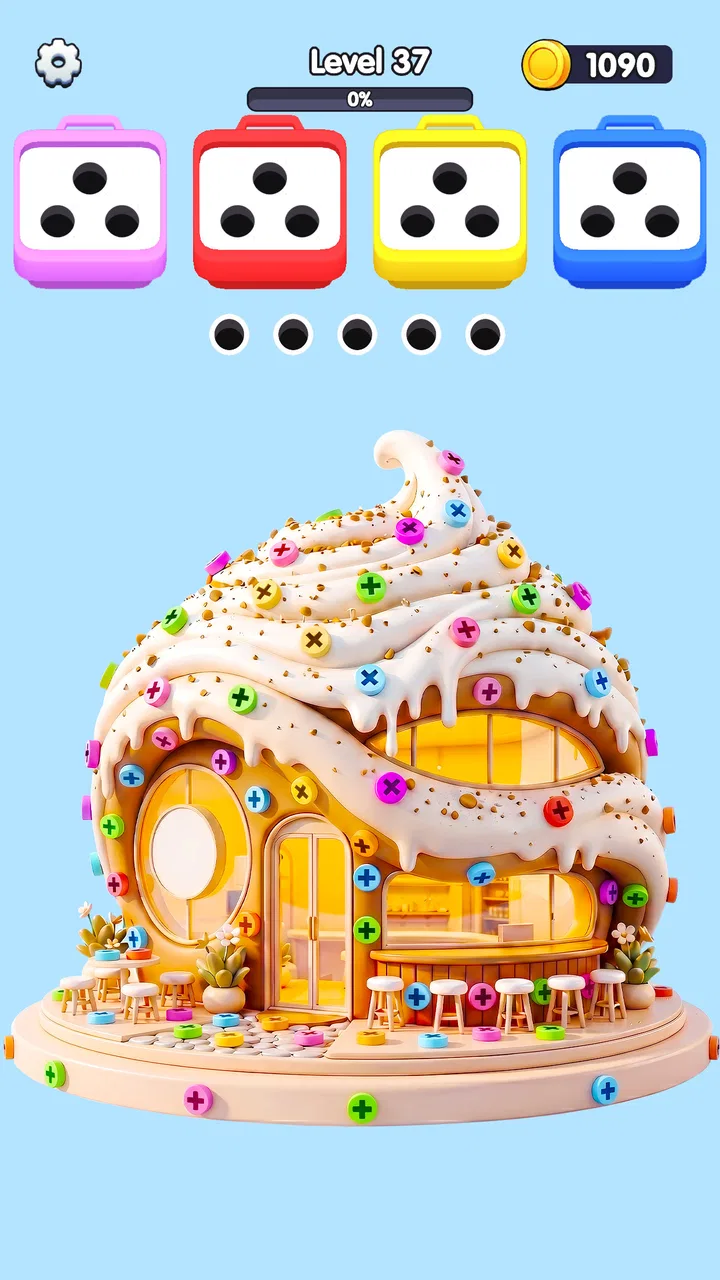
Screw Tap Jam™: Screw Puzzle
- 4.8
- Rating
- 1.00M
- Installs
- Free
- Price

 Analysis by App-foxy
I found Screw Tap Jam™: Screw Sort 3D easy to understand within seconds and surprisingly difficult to put down during my first few sessions. It is a casual puzzle game from Shinrays Brain Studio built around arranging and removing screws, nuts, and bolts in three-dimensional boards. The basic idea is familiar, but the physical-looking pieces make each move feel more deliberate than a standard tile-matching game. I came expecting a quick distraction and ended up paying closer attention to the order in which I opened spaces.
The game is free to start, carries an Everyone age rating, and runs on Android devices using version 6.0 or later. Its current version is 3.501, and it has already passed one million installs. Those details matter because this is clearly designed as an accessible pick-up-and-play title rather than a specialist puzzle experience. I would recommend it most to people who enjoy short logic challenges, tactile visuals, and gradual problem solving without needing a complicated story or a large tutorial.
Why the first week feels so satisfying
The strongest part of the opening experience is the way the board communicates its rules visually. Screws hold pieces in place, empty slots create immediate pressure, and every successful removal changes what can be reached next. I did not have to memorize a long set of instructions. Instead, I learned by watching which pieces were blocked and which move would create room for the following one.
You May Also Like

 Blood Strike: 2.5 Anniversary
Blood Strike’s Loadouts Turn Every Drop Into a Tactical Gamble
A close look at Blood Strike’s custom loadouts: how fast access to signature weapons reshapes its battle royale rhythm, rewards preparation, and narrows the gap between fights.

 Pandora - Music & Podcasts
Pandora’s Music Is Easy to Start, but Harder to Recover
Pandora’s strength is its low-effort path from a seed to a station. Its weak spot is how much confidence it asks you to place in connection, setup, and quiet recovery.

 8 Ball Pool
 Is Built on Rivalries, Rematches, and Routine
A close look at the rivalries, rematches, shared routines, and unanswered safety questions that turn a quick pool match into a persistent mobile community.

 Samsung Music
’s Quiet Strength Is Playing What You Already Own
Its reach comes less from spectacle than from dependable access to a personal library. That simplicity is both the app’s strongest retention engine and its ceiling.

 AccuWeather: Weather Radar
AccuWeather Review: A Quick, Clear Forecast for Everyday Decisions
For everyday plans, the best forecast is the one you can understand quickly. AccuWeather makes rain timing, radar, and local conditions easy to act on, with a few trade-offs.

 Hill Climb Racing
Why Hill Climb Racing Still Turns Crashes Into One More Run
A tiny car, a bumpy hill and one more upgrade: Hill Climb Racing keeps resurfacing because its simple chaos makes every near-miss feel personal.
More From Our News Desk
View All News


That clarity gives the first sessions a pleasant rhythm. I could begin a level while waiting for something, make progress in a few moves, and still feel that the result came from planning rather than random tapping. The three-dimensional presentation also helps the game stand apart from flat sorting puzzles. Depth is not just decoration; it encourages me to inspect the board from the perspective the game provides and think about access before committing to a move.
The most useful early habit is to resist removing the first available screw simply because it is obvious. I found better results by checking the board for pieces that are serving as bridges between several areas. Opening one section can reveal a useful slot, but it can also leave a later piece with nowhere to go. This makes the game more interesting than a simple “clear whatever is visible” routine.
Another practical tip is to treat empty spaces as resources rather than rewards. A free slot is valuable only if it supports the next sequence of moves. When I used every available opening immediately, I often created a crowded middle position and had fewer choices afterward. Saving one space for an awkward piece made some boards noticeably easier. That small change in play style is one of the first signs that the game has more thought behind it than its casual appearance suggests.
The early appeal also comes from its low commitment. I do not need to prepare for a long session, follow a narrative, or remember complicated character abilities. The focus stays on the current arrangement. For a commuter, a student taking a break, or anyone who prefers a quiet puzzle between tasks, that simplicity is a real strength.
Still, the first-week experience is not perfect. Players who want a deep puzzle system with several distinct mechanics may find the central action narrow. The game’s pleasure comes from applying the same broad logic to changing arrangements, not from constantly learning new rules. That is enjoyable when I am in the mood for repetition with variation, but less compelling when I want a dramatic change of pace.
Learning the board instead of chasing speed
I also think the game rewards patience more than fast tapping. There is a temptation to move quickly because the controls are simple, yet speed can hide the consequences of a poor order. I had better sessions when I paused after each removal and reassessed the remaining structure. That makes it a useful wind-down game: the challenge is active enough to occupy my attention, but not so demanding that it becomes mentally exhausting at once.
For new players, I would suggest looking for three things before making a move: which pieces are currently accessible, which screw is blocking the largest area, and whether the next removal will leave a practical place for the freed piece. This approach is more reliable than focusing only on the most colorful or visually prominent object. It also makes failures feel informative, because I can usually identify the point where I spent space or opened the wrong route.
The game’s average rating is 4.9 from around 41 thousand ratings, with roughly 1.2 thousand written reviews. I do not treat those figures as proof that every player will enjoy it, but they do match my impression that the basic loop is immediately approachable. The high reception makes sense for a title that explains itself through its board design and offers a clear goal without demanding much setup.
What remains useful after the novelty wears off
The more important question is whether the game deserves a place on my phone after the first burst of curiosity fades. In my experience, it has recurring value when I use it as a short concentration exercise rather than as a game I must play for a long uninterrupted stretch. The compact puzzle loop fits naturally into small gaps in the day, and the physical screw-and-bolt theme gives the familiar sorting format enough identity to remain recognizable.
A realistic use case is a ten-minute break after finishing a work task. I can open a board, focus on the order of accessible pieces, and stop once the session no longer feels refreshing. That works better for me than launching a larger game that expects a long commitment. The same applies before bed, although players who become frustrated by a failed puzzle may prefer something more passive at that time.
Its month-to-month value depends on whether changing layouts are enough to keep you interested. If you enjoy examining arrangements and improving your decision-making, the game can become a dependable routine. I like that the challenge is not based on reflexes, so improvement feels connected to recognizing patterns and managing space. A player who prefers action, competition, or a strong sense of progression may not feel the same pull.
Compared with ordinary match-three games, this one asks for more attention to order and access. A match-three board often gives immediate feedback through combinations, while this game makes a single mistake more consequential because it can reduce the room available for later pieces. Compared with classic sorting games, the screw-and-bolt presentation adds a stronger sense of physical obstruction. The trade-off is that the underlying interaction may feel less varied if you have already played many object-sorting puzzles.
I would not choose it as my main game if I wanted a story, character development, or a social layer. It is better understood as a focused puzzle tool: open it, inspect the board, make a sequence of decisions, and move on. That narrow purpose is not a flaw by itself. It becomes a limitation only when someone expects a broader entertainment package.
Small decisions that improve repeat sessions
One of the less obvious ways to extend its usefulness is to change the goal of each session. Sometimes I play simply to finish a board. At other times, I try to solve more carefully by preserving options and avoiding unnecessary moves. This turns a familiar level into a small exercise in efficiency without requiring a separate mode or a competitive ranking system.
I also found it helpful to stop after a mistake instead of immediately repeating the same pattern. Taking a moment to identify whether I lost because of poor space management or because I ignored a blocked route made the next attempt more purposeful. That habit prevents the game from becoming mindless tapping and gives the repeated boards a learning component.
Another useful trade-off is choosing when not to use assistance if the game presents a difficult position. A quick rescue can keep a session pleasant, but relying on help too early removes the part I find most satisfying: discovering the correct order myself. On the other hand, refusing any aid when I am tired can turn a relaxing break into irritation. The best balance is to treat assistance as a way to protect the session, not as a substitute for thinking.
The game is also suitable for different attention levels. When I have only a little energy, I can focus on obvious removals and accept a slower pace. When I am more alert, I can inspect the entire board and plan several moves ahead. That flexibility contributes more to its lasting value than the theme alone, because it lets the same game serve as either a light distraction or a modest logic challenge.
Maintenance, spending, and the points where fatigue appears
Maintenance is relatively simple in practical terms. The game is free to download and play, so there is no purchase decision required before trying the core experience. In-app purchases range from $0.99 to $99.99 per item, which means optional spending can cover a wide range. I would approach those purchases carefully and decide in advance whether I am paying for convenience or for something I genuinely need to enjoy the puzzles.
For me, the main maintenance burden is not money but attention. A casual puzzle game can become repetitive if I open it automatically without a clear reason. I get more value when I use it for a defined break or when I specifically want a board-based logic task. If it becomes part of a routine, I would keep the sessions short enough that the familiar loop remains pleasant rather than turning into background behavior.
Players should also consider their tolerance for interruptions and repeated prompts while using any free mobile game. I do not want to invent a specific advertising schedule or claim a particular monetization behavior, but the presence of optional purchases is enough reason to review each offer before accepting it. A free entry point is convenient; it does not mean every optional path will suit every budget.
The first major source of fatigue is mechanical repetition. Screws, nuts, bolts, slots, and blocked pieces create a distinctive visual identity, but the same identity can lose its freshness over time. If the player’s enjoyment depends mainly on discovering new mechanics, the appeal may decline sooner. If the player enjoys refining choices within a stable ruleset, the repetition can feel more like practice.
The second source is failure caused by limited space. That pressure is central to the puzzle, yet it can sometimes feel less like a clever challenge and more like a punishment for one early decision. I appreciated the tension when I could understand what went wrong. I was less enthusiastic when the board became crowded before I had enough information to plan confidently. This is a game where patience helps, but patience cannot remove every frustrating position.
The third source is the absence of a broader reason to return. Without needing a story or social competition, I can enjoy a few boards and close the app. That is excellent for a lightweight game, but it also means the title may not create a strong long-term obligation. It earns repeat visits through the puzzle loop itself, not through a large world that keeps unfolding.
Who should install it, and who should skip it
I would point this game toward someone who likes visual organization, careful sequencing, and short sessions. It is especially suitable for players who enjoy casual puzzles but want a little more spatial awareness than a basic matching game provides. It can also work for people who prefer games that are easy to learn and do not require fast reactions.
I would be more hesitant to recommend it to anyone who needs constant novelty, competitive multiplayer, or a strong narrative hook. Players who dislike losing because of a blocked route may find the space-management design stressful. Likewise, anyone looking for a completely hands-off relaxation game should choose something gentler, because this title expects regular decisions even though the controls are simple.
Device compatibility is broad enough for older Android users because the minimum requirement is Android 6.0, but the actual comfort of play will still depend on the phone’s screen and performance. A larger display can make the three-dimensional arrangement easier to inspect, while a smaller screen may require more careful tapping. I would try a few boards before deciding whether the visual layout feels comfortable for long-term use.
The Everyone rating makes it an approachable choice for a broad audience, but age suitability does not automatically mean universal enjoyment. The important question is whether the player likes sorting, obstruction, and planning. The game’s presentation is friendly, yet its later appeal still depends on accepting the same central type of problem repeatedly.
My long-term verdict on keeping it installed
After the novelty fades, I think this game earns space on a phone as a reliable short-session puzzle, not as an all-purpose mobile favorite. Its best qualities are the clear visual rules, the satisfying sense of opening a blocked board, and the way empty slots force me to think ahead. Shinrays Brain Studio has kept the entry point simple while giving the screw-based design enough structure to make each decision matter.
Its weaknesses are equally clear. The core interaction can become familiar, the limited-space pressure may frustrate players who prefer forgiving puzzles, and the long-term motivation is mostly self-directed. Optional purchases also deserve a measured approach, particularly because the available item prices extend from small amounts to much larger ones. I would not spend automatically just to remove a moment of difficulty; I would first decide whether the game is still adding value to my routine.
The strongest lasting use is as a deliberate break: a few boards when I want to focus on something concrete without starting a major game. The weakest use is as an endlessly escalating hobby for someone who needs a constant stream of new systems. That distinction matters more than the attractive theme. The game succeeds when its stable rules feel calming and thoughtful, and it loses ground when repetition starts to feel like maintenance.
With an average rating of 4.9 and more than one million installs, it has clearly found an audience for this style of casual puzzle. My own recommendation is positive but specific: install it if you want a free screw-sorting challenge that rewards planning and fits into everyday gaps. Keep it if you still enjoy examining the board after the first-week excitement has passed. If you need narrative, social play, or major mechanical variety, your storage space is probably better reserved for a different kind of game.
FAQs for Screw Tap Jam™: Screw Puzzle
01What is the main objective of Screw Tap Jam™: Screw Sort 3D?
Screw Tap Jam™: Screw Sort 3D challenges players to sort and organize screws into their designated slots based on size and color. The game is designed to test your attention to detail and problem-solving skills in a vibrant 3D environment. As levels progress, the complexity increases, providing a satisfying challenge for gamers of all ages.
02Is Screw Tap Jam™: Screw Sort 3D suitable for all age groups?
Yes, Screw Tap Jam™: Screw Sort 3D is designed to be family-friendly and suitable for all ages. Its intuitive controls and engaging graphics make it accessible for younger players, while the increasing difficulty levels offer a challenge for adults. It’s a great game for both casual and more serious gamers.
03Does Screw Tap Jam™: Screw Sort 3D require an internet connection to play?
Screw Tap Jam™: Screw Sort 3D can be played offline, making it a perfect choice for those who want to enjoy gaming on the go without worrying about data usage. However, certain features, such as leaderboard updates and social sharing, may require an internet connection.
04Are there any in-app purchases in Screw Tap Jam™: Screw Sort 3D?
Yes, while Screw Tap Jam™: Screw Sort 3D is free to download and play, it offers optional in-app purchases. These can include items like additional hints, removing ads, or purchasing aesthetic upgrades. Players can enjoy the core experience without spending money, but purchases can enhance gameplay.
05What platforms is Screw Tap Jam™: Screw Sort 3D available on?
Screw Tap Jam™: Screw Sort 3D is available on both Android and iOS platforms. Whether you own a smartphone or tablet, you can download the game from the Google Play Store or Apple App Store. The game is optimized to run smoothly across a wide range of devices, ensuring an enjoyable experience.
Pros
- Engaging 3D graphics enhance gameplay.
- Simple controls make it easy to play.
- Variety of levels keeps it interesting.
- Challenging puzzles stimulate the mind.
- Offline mode available for on-the-go fun.
Cons
- Ads can be intrusive during gameplay.
- Limited hints for challenging levels.
- In-app purchases can be pricey.
- Some levels feel repetitive.
- Occasional app crashes reported.

Screw Tap Jam™: Screw Puzzle
Gallery